
How To Taste Wine Like a Pro
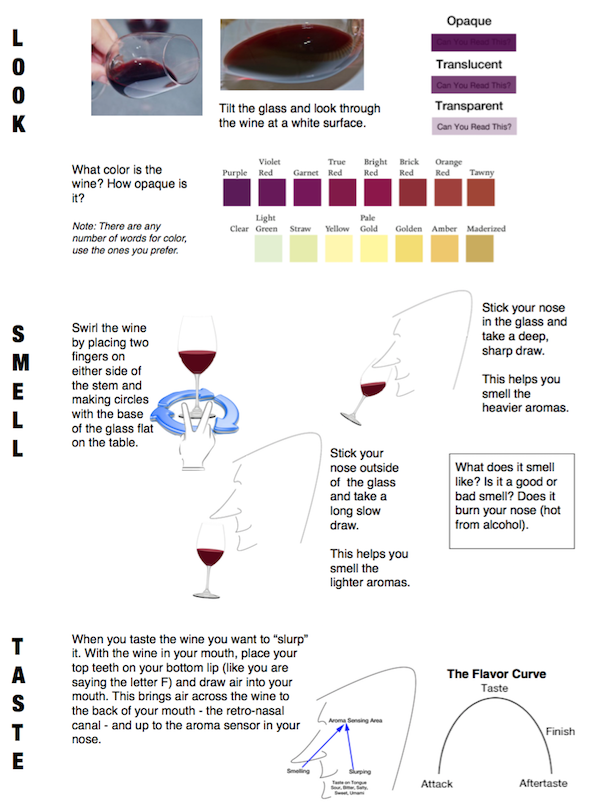 Download Graphic and Associated Tasting Sheet
MW, MS, CWE, no matter which set of initials you are after one thing is certain: you need to be a great blind taster to pass. As with any number of skills some people are born with inherent talents that make blind tasting easier. Unlike so many other skills, blind tasting doesn't rely on talent alone. It requires tips, tricks, and above all else, practice.
Learn to ignore most of what everyone is telling you
The first thing you need to do is stop reading about blind tasting, and learn to ignore most of what everyone is telling you - after reading this article of course. The reason? Subjectivity. It doesn't matter if someone tells you that Cabernet Sauvignon has a distinctive black currant note if all you taste is an indistinct dark fruit. What matter is that you learn to recognize your very own individual markers for each wine.
Unless you have limitless resources, gather a group of like minded tasters to help offset the cost of the wine. You are going to start tasting wine at least once a week, more if you can. You will be tasting them blind, and you will be taking notes.
Always taste out of the same shape glasses. Ideally invest in a set or three of INAO wine tasting glasses. Chances are you will be tested in these exact same glasses, so you will have a head start if you are used to them. Every time I settle down in a new part of the world I buy another set (which to a wine educator means 144 - you can get away with 6 or 12).
When you have eliminated the impossible, whatever remains, however improbable, must be the truth - A.C. Doyle
Guessing what a wine is and where it comes from is like any other detective work. You gather the evidence and start out by eliminating what it is not. As with a crime scene you want to first observe with your eyes what is there, and what is missing. What color is the wine, what hue, does it have hints of orange, how opaque is it? Look at the rim, does the color make it all the way out, or is there a ring of colorless liquid surrounding the wine? If so, how wide is it?
I can not stress enough that a huge amount of information comes from this visual examination. Hints on grape variety, region, and age are all there for anyone practiced enough to observe the clues. Long before you have touched the glass you should be able to eliminate a huge swath of possibilities.
It is much less important what I tell you, than what you learn to observe on your own
I can go on and on about the particulars, but as I have already stated it is much less important what I tell you, than what you learn to observe on your own. Look at the wine, take detailed notes, and once the bag is removed go back to your notes and highlight the clues that did, or could have told you about the wine. Don't worry about getting it right when you are just getting started. At this point it is much more important to be good at gathering clues than knowing what they mean.
Your next set of clues is going to come from actually interacting with the wine, the aromas, and the flavors. One of the aromas you are going to want to learn to recognize has nothing to do with the fruit descriptions writers, and most of your fellow tasters, will fling about. The aroma in question is bouquet - or technically: tertiary aromas. This is the smell of bottle aging. More expensive wines will tend to be in bottle longer before they are released. While browning will tell you that a wine is very old, tertiary aromas will tell you about bottle age long before there are any visual clues.
Don't be swayed by your fellow tasters into changing your notes
Specific fruit aromas and flavors in wine are a huge hint, but they are incredibly subjective. Don't be swayed by your fellow tasters into changing your notes. Look at what you wrote and highlight the flavors you personally associate with that grape variety. You are not trying to change what you taste, you are trying to recognize what your own personal set of tastes tell you about a wine. As with the visual clues, you are trying to build a personal data base that correlates what you observed with what the wine turns out to be.
Getting it right is much less important than being consistent - up until the exam at least. If you always get the same clues for the same type of wine, but get the conclusion wrong, you are on your way to being a great blind taster. Experience and repetition will help point you towards the right wine with time, but if you are missing the clues no amount of lucky guessing is ultimately going to help you.
Learn your regions and their climates
Learn your regions and their climates. Once you have learned to identify a varietal you really have to know where it is grown. Similarly learn to recognize the natural grape acidity of cooler regions and alcohol of warmer ones. These will help you narrow down where in the world the wine comes from.
One of the most important factors in doing well in a blind tasting is learning to recognize quality. Once you have decided what the varietal is, and where it could have come from, you need to speak to how good, or at least how expensive it is. This is especially hard for wines that you are not altogether fond of. You can't just say "I like it (or not) therefore it is…" If for no other reason than exams such as the MW will make you defend your assertion of quality.
Instead, look for hints such as the amount of dry extract (when you remove the liquid, everything else that is left - often associated with the "body of the wine). It is likely that the examples you find with high dry extract are from vineyards with low yields. A sign that the wine will cost more. So too does new oak speak to the cost of making the wine. Look for other indicators that you personally can recognize.
Vintage charts are of dubious help in buying wine, but can be critical for guessing what year a wine might have been harvested. It is not the vintage rating, but rather the climatic conditions that you want to be familiar with. Look up the vintage of a wine after the tasting, and add the conditions to your notes, so you can see what clues the wine gave to its birthdate.
Guessing the origin, age and quality of wine is a parlor trick
Guessing the origin, age and quality of wine is a parlor trick, but one well regarded in the industry. Certifications and other forms of bone fides often depend on your ability to perform what you and I know is detective work, but looks to the outsider as magic. I am going to end with an anecdote about blind tasting (not mine, but I don't remember where I first came across it).
There once was a man who astounded his friends with his ability to flawlessly guess what wine they had served him. The host, suspicious of the ability, and noticing that the seemingly miraculous taster always freshened up before playing the game, decide to potentially trick his guest. In place of the usual empty bottle of wine, hidden away in another room, the host substituted another. As he thought might happen, the guest's guess this night was not only wildly wrong, but identical to the trap he had sprung.
The moral of the story? Use everything you can to determine what the wine is - just don't get caught.